Fast Answer: What a Lithium Conversion Involves

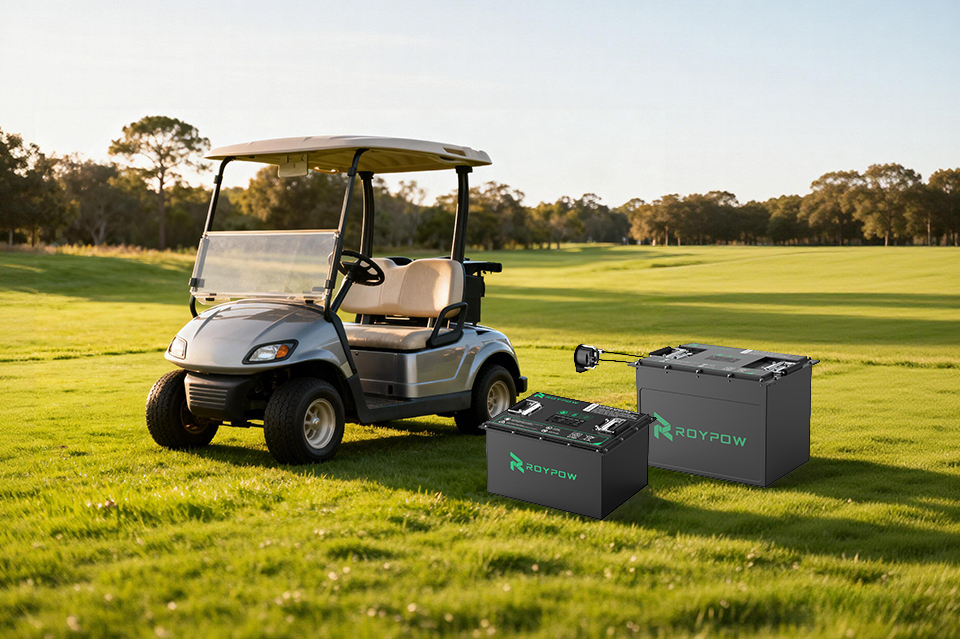
A golf cart lithium battery conversion replaces heavy lead-acid batteries with a lighter, smarter lithium iron phosphate battery system, usually called LiFePO4. For most carts, the process includes confirming system voltage, removing old batteries, cleaning and inspecting the battery bay, installing a compatible lithium pack, connecting the correct charger, adding or configuring a state-of-charge meter, and testing the cart safely before regular use.
For a typical 36V, 48V, or 72V golf cart, a properly selected lithium battery system can reduce weight, improve acceleration, deliver steadier voltage under load, shorten charging time, reduce maintenance, and provide longer service life than flooded lead-acid batteries. The most important point is compatibility: the cart voltage, controller limits, motor condition, charger type, cable size, mounting space, and accessory wiring must all match the new battery system.
Globally, lithium conversions are becoming common not only on golf courses, but also in resorts, gated communities, airports, ports, campuses, farms, factories, warehouses, holiday parks, and urban mobility fleets. In markets such as the United States, the United Kingdom, Germany, Brazil, South Africa, Australia, Japan, Korea, the Netherlands, the Middle East, and Southeast Asia, operators are moving away from watering schedules, acid corrosion, and frequent lead-acid replacement cycles.
If your cart uses a standard 36V, 48V, or 72V platform from brands such as Club Car, EZGO, Yamaha, ICON, Tomberlin, Advanced EV, Evolution, Bintelli, Garia, or many utility vehicle makers, conversion is often practical. However, lithium is not a simple “any battery fits any cart” decision. A safe conversion requires the right continuous current rating, peak current rating, onboard battery management system, charger communication or charge profile, and proper physical installation.
Owners who want a purpose-built solution can review ROYPOW Golf Cart Batteries, including models designed for common golf cart voltage platforms. For carts using 36V systems, check 36V Golf Cart Batteries. For the most common modern platform, see 48V Golf Cart Batteries. For higher-voltage utility and performance applications, consider a 72V Lithium Golf Cart Battery.
As a quick decision rule: if your cart is mechanically sound, the controller and motor are in good condition, and the battery tray can securely accept the lithium pack, conversion is usually worthwhile. If the cart has failing brakes, damaged cables, controller faults, corroded frame sections, or unknown aftermarket modifications, repair those issues before installing lithium. A battery upgrade should improve a reliable platform, not hide unsafe problems.
| Question | Quick Guidance | Why It Matters |
|---|---|---|
| What voltage is my cart? | Confirm 36V, 48V, or 72V before buying. | Wrong voltage can damage the controller and charger. |
| Can I use my old charger? | Usually no, unless it has a lithium profile approved by the battery maker. | Lead-acid charge curves can overcharge or undercharge lithium. |
| Do I need a battery meter? | Yes, use a lithium-compatible SOC meter or app. | Lead-acid meters often read lithium incorrectly. |
| Will the cart be faster? | It may feel quicker because voltage stays steadier and weight drops. | Speed also depends on controller, motor, tires, and gearing. |
| Is lithium maintenance-free? | It eliminates watering and acid cleaning, but periodic inspections remain necessary. | Cables, mounts, firmware, and charger condition still matter. |
| Is conversion legal globally? | Rules vary by country, city, resort, road-use category, and workplace policy. | Public-road carts may need inspection, insurance, lighting, and certification. |
This table shows why a lithium conversion should be treated as an electrical system upgrade, not just a battery swap. The safest conversions start with measurement, documentation, and correct product selection.
Compatibility Check: Voltage, Brands, and Cart Types

Before buying a lithium golf cart battery, identify the cart brand, model year, voltage, motor type, controller rating, charger setup, and accessory wiring. Many older carts use six 6V batteries for 36V, six 8V batteries for 48V, four 12V batteries for 48V, or six 12V batteries for 72V. Newer carts may already have integrated lithium systems, which require different service steps than converting from lead-acid.
To confirm voltage, inspect the existing battery bank and count the batteries. Multiply the number of batteries by the voltage printed on each case. If the labels are missing, count the filler caps on flooded batteries: three caps often indicate 6V, four caps indicate 8V, and six caps indicate 12V. However, do not rely only on appearance. Use a multimeter and check the cart’s manufacturer plate, controller label, and charger rating.
Brand compatibility depends on more than voltage. Club Car DS and Precedent carts may have different tray layouts and onboard computer considerations depending on model year. EZGO TXT, RXV, and Marathon platforms have different controller and brake systems. Yamaha G-Series, Drive, and Drive2 carts can vary in wiring and battery bay space. Low-speed vehicles and street-legal carts may add DC-DC converters, lighting harnesses, turn signals, horns, USB ports, and audio systems that must be powered correctly.
In global fleet markets, compatibility also includes climate. A cart used in Dubai resort heat, Singapore humidity, Toronto winter storage, Cape Town coastal air, Sydney suburbs, Rotterdam logistics areas, or mountain resorts in Japan faces different demands. LiFePO4 chemistry is stable and well suited for motive power, but charge temperature limits, enclosure rating, ventilation around electronics, and corrosion protection should be considered for each location.
| Cart Platform | Common Voltage | Conversion Notes | Typical Use |
|---|---|---|---|
| Club Car DS | 36V or 48V | Check model year, OBC, tray size, and solenoid condition. | Golf courses, private communities, resorts. |
| Club Car Precedent | 48V | Often a strong lithium candidate when wiring is clean. | Golf fleets, campuses, hospitality. |
| EZGO TXT | 36V or 48V | Confirm controller current draw and forward/reverse system. | Personal carts, parks, rental fleets. |
| EZGO RXV | 48V | Regenerative braking and controller behavior require careful matching. | Golf, security, facility transport. |
| Yamaha Drive and Drive2 | 48V | Check battery hold-down options and accessory wiring. | Clubs, resorts, commercial sites. |
| Utility and LSV carts | 48V or 72V | Verify road-use equipment, DC-DC converter, and peak current demand. | Street use, ports, airports, industrial parks. |
The table highlights typical platforms, but it is not a substitute for checking the exact cart. In large fleets, two carts with the same exterior body can have different controllers, chargers, or accessory modifications due to previous repairs.
Voltage selection should match the cart, not personal preference. If the cart is built as a 48V system, installing a 72V pack without changing the controller, motor, solenoid, and wiring can cause serious damage. Likewise, using an undersized battery with insufficient discharge current can lead to battery management system protection events on hills, during acceleration, or when carrying passengers and cargo.
For common residential and fleet conversions, 48V lithium batteries are the mainstream choice because many modern carts use 48V architecture. Heavy-duty carts, people movers, and utility models may benefit from 72V systems if originally designed for that voltage. Older 36V carts can still be upgraded successfully, especially for light-duty golf course and neighborhood use, as long as expectations are realistic.
Local supply and service also matter. A cart in Los Angeles, Miami, Hamburg, London, São Paulo, Johannesburg, Dubai, Melbourne, Tokyo, Seoul, or Jakarta should have access to compatible chargers, replacement cables, mounting hardware, and technical support. For buyers comparing options online, Golf Cart Batteries can provide another reference point for product categories and purchasing considerations.
Essential Tools and Materials for the Upgrade

A clean installation starts with the correct tools. Working on a golf cart battery bay involves high current, heavy components, and corrosive residue from old lead-acid batteries. Prepare everything before disconnecting the pack so the cart is not left partially disassembled in a shared garage, workshop, resort maintenance area, or fleet yard.
At minimum, you need insulated hand tools, a digital multimeter, torque wrench, personal protective equipment, battery lifting tools, neutralizing solution for acid residue, terminal protectant, cable ties, heat shrink, and the installation manual for the new battery. Depending on the kit, you may also need mounting brackets, a lithium-compatible charger, a SOC meter, a DC-DC converter, CAN or communication cables, and new battery cables.
Do not reuse damaged lead-acid cables simply because they fit. Lithium batteries can deliver high current with less voltage sag, so weak cable ends, loose crimps, undersized conductors, and corroded lugs become greater risks. If cables are stiff, green, hot after driving, cracked, or poorly repaired, replace them. Cable gauge should match the battery maker’s recommendation and the controller demand.
| Tool or Material | Recommended Specification | Purpose |
|---|---|---|
| Digital multimeter | DC voltage range above system voltage | Confirms pack voltage, polarity, and charger output. |
| Insulated socket set | Correct sizes for terminals and hold-downs | Reduces accidental short-circuit risk. |
| Torque wrench | Range suitable for battery terminals | Prevents loose or over-tightened connections. |
| Safety gloves and eye protection | Chemical and electrical protection | Protects from acid residue and accidental sparks. |
| Lifting strap or battery carrier | Rated for old lead-acid battery weight | Helps remove heavy batteries safely. |
| Lithium charger | Matched voltage and charge profile | Charges the LiFePO4 pack correctly. |
| SOC meter | Lithium-compatible display or app | Shows realistic remaining capacity. |
| Mounting hardware | Non-conductive or corrosion-resistant where appropriate | Secures the battery against vibration. |
This tool list supports both home users and professional installers. A fleet workshop at a golf club in Scotland, a resort in Phuket, a marina in Florida, or a factory campus near Shanghai may already have most tools, but the lithium-specific charger and meter are still essential.
When choosing materials, consider operating environment. Stainless hardware helps in coastal regions such as Durban, Barcelona, Sydney, Busan, and Miami. Weather-resistant connectors are useful in tropical rain climates. In colder regions such as Canada, northern Europe, Korea, and alpine tourist areas, confirm low-temperature charge protection and storage procedures.
For charger selection, use a lithium charger approved for the battery voltage and chemistry. A dedicated Golf Cart Battery Charger is designed to match lithium charging requirements and can help protect performance and service life. Charger compatibility is one of the most common causes of poor conversion results, so do not treat it as an afterthought.
Safety Comes First: Critical Precautions Before Work
High-current battery systems require disciplined safety practices. Even a 36V cart can produce dangerous short-circuit current. A wrench dropped across terminals can melt metal, ignite insulation, and cause burns. Old flooded batteries add chemical hazards because acid residue can remain on trays, hold-downs, cables, and the underside of the seat.
Park the cart on a level surface, turn the key off, remove the key, set the parking brake, switch tow/run to tow if applicable, and disconnect charging power. Remove jewelry, watches, rings, necklaces, and loose metal objects. Keep children, pets, customers, and untrained staff away from the work area. Use wheel chocks if the cart is on any slope.
Ventilation is important when working around old lead-acid batteries. Although lithium batteries do not require watering and do not normally vent like flooded lead-acid batteries during regular use, the old pack may still release gas or contain acid residue. Avoid smoking, sparks, or grinding near the cart. If a battery case is swollen, cracked, leaking, or hot, stop and follow local hazardous waste procedures.
Document the original wiring before disconnecting anything. Take clear photos from multiple angles, label cables, and mark positive and negative leads. Many carts have accessory wires added by previous owners for lights, fans, radios, GPS trackers, irrigation tools, or security beacons. These accessories should not be randomly connected to a lithium pack without proper voltage conversion and fuse protection.
Never bypass a lithium battery management system. The BMS protects against overcharge, over-discharge, short circuit, over-current, and temperature extremes. If the BMS opens protection, find the cause instead of repeatedly forcing the cart to run. Common causes include undersized battery capacity, steep hills, overloaded carts, poor cables, incorrect controller settings, or incompatible regenerative braking behavior.
Disposal is another safety and environmental issue. Lead-acid batteries are recyclable but must be handled through approved channels. Many cities and ports, including Rotterdam, Singapore, Los Angeles, Hamburg, and Melbourne, have strict rules for transporting and recycling batteries. Do not place old batteries in general waste, leave them outdoors, or drain acid. Use local recycling centers, battery dealers, or authorized fleet waste contractors.
Steps 1–3: Taking Out the Existing Lead-Acid Pack
Step 1: Inspect and document the cart. Before disconnecting the pack, identify the main positive cable, main negative cable, series jumpers, charger receptacle wires, accessory feeds, and any controller or solenoid connections. Take photos and label cables with durable tags. If the cart has an onboard computer or manufacturer-specific charging system, record the wiring before making changes.
Check the battery tray for rust, cracks, acid damage, and loose mounts. Lead-acid batteries are heavy, so tray fatigue is common in older carts. A lithium battery may be lighter, but it still must be securely supported. If the tray is badly corroded, repair or replace it before installing the new battery. Do not rely on the battery case as a structural brace.
Step 2: Disconnect power in the correct order. With the cart off and charger unplugged, disconnect the main negative cable first, then the main positive cable. After that, remove series jumpers and accessory wires. Keep cable ends separated and insulated to prevent accidental contact. Avoid placing tools across battery terminals or frame metal.
If any terminal is stuck due to corrosion, use proper penetrating treatment and patience. Do not hammer battery posts or pry aggressively against cases. Damaged flooded batteries can leak acid. If corrosion is heavy, neutralize residue with an appropriate solution and clean using non-metallic brushes where practical. Wear gloves and eye protection throughout.
Step 3: Remove and recycle the old batteries. Lift batteries one at a time using a proper carrier or lifting strap. A single lead-acid golf cart battery can be heavy enough to injure your back or fingers. Get help for difficult lifts. Place removed batteries upright in a stable area away from drains, soil, and pedestrian traffic.
Once removed, clean the battery bay thoroughly. Neutralize acid residue, rinse carefully if appropriate for the cart and location, dry completely, and inspect the metal tray, frame, cables, and hold-down points. Replace cracked insulation, burnt connectors, or weak terminals. A lithium conversion is the ideal moment to correct years of corrosion and poor repairs.
In commercial environments, record battery serial numbers, disposal receipts, and installation dates. Golf clubs, airports, resorts, and industrial facilities often need documentation for environmental compliance and asset management. A good record also helps future technicians diagnose issues quickly.
Steps 4–6: Fitting the Lithium Battery System
Step 4: Position and secure the lithium pack. Place the new lithium battery or battery modules in the tray according to the manufacturer’s instructions. Confirm that the pack is level, supported, and clear of sharp edges, moving parts, seat hinges, and hot components. Use approved brackets or hold-downs. The battery should not slide, bounce, or rotate during braking, cornering, or transport on trailers.
Many modern lithium golf cart batteries are drop-in-ready in the sense that they are designed to simplify replacement of lead-acid systems. However, “drop-in” does not mean careless. The battery still needs correct mounting, cable routing, fuse protection where required, and correct charger setup. If the battery includes communication cables, Bluetooth monitoring, CAN communication, or external display wiring, route those cables away from abrasion and heat.
Step 5: Connect main power cables correctly. Confirm polarity with a multimeter before making final connections. Connect positive to positive and negative to negative. Use the recommended torque for terminal bolts. Loose terminals create heat and voltage drop; over-tightened terminals can damage threads or bus bars. After tightening, gently check that cables cannot rotate on the terminal.
If the conversion uses multiple lithium modules in parallel or series, follow the battery maker’s balancing and connection procedure exactly. Do not mix old and new lithium batteries, different capacities, different brands, or different states of charge unless the manufacturer specifically allows it. For most golf cart owners, a single integrated pack with a built-in BMS is simpler and safer than assembling separate modules.
Step 6: Address accessories and voltage converters. Many carts have 12V accessories. A 48V or 72V lithium pack should not feed 12V lights directly unless the accessory system is designed for that voltage. Use a properly rated DC-DC converter with fuse protection. This applies to headlights, brake lights, turn signals, horns, USB ports, fans, radios, GPS units, sprayers, and work lights.
For commercial carts used in airports, resorts, ports, warehouses, farms, and security patrols, accessory loads can be significant. A cart with roof lighting, radios, tracking equipment, and refrigeration boxes needs more planning than a simple two-seat golf cart. Add up accessory current demand and verify that the DC-DC converter has enough capacity with a safety margin.
| Application | Recommended Focus | Battery Consideration |
|---|---|---|
| Golf course fleet | Reliable daily rounds and fast turnaround | Consistent range, charger scheduling, fleet monitoring. |
| Resort transport | Passenger comfort and quiet operation | Stable voltage under repeated stop-start use. |
| Gated community | Neighborhood driving and light cargo | Range, safety, and simple charging at home. |
| Airport or port utility | High duty cycle and safety compliance | Rugged mounting, documentation, and service support. |
| Industrial campus | Tools, parts, and maintenance transport | Accessory power and higher current capability. |
| Farm or estate | Uneven ground and cargo loads | Peak current rating and secure installation. |
The application table shows that battery choice should reflect real operating patterns. A light personal cart and a hotel luggage cart may both be 48V, but their daily load profiles are very different.
For buyers selecting product types, ROYPOW offers lithium solutions across 36V, 48V, and 72V golf cart categories. A cart owner replacing an older 36V lead-acid bank may evaluate 36 Volt Lithium Golf Cart Batteries, while high-volume fleets often focus on 48 Volt Lithium Golf Cart Batteries because of the broad availability of compatible cart platforms.
Steps 7–9: Charger, SOC Display, and Final Wiring
Step 7: Install or configure the lithium charger. A lithium battery needs a suitable charge profile. Lead-acid chargers are designed around different voltage curves and finishing behavior. Some old chargers depend on lead-acid pack voltage to turn on, while others use algorithms that are not appropriate for LiFePO4. Using the wrong charger can result in incomplete charging, nuisance faults, reduced battery life, or safety risks.
Install the charger according to the battery maker’s instructions. If the charger is onboard, secure it where it has ventilation and protection from water spray. If it is offboard, confirm that the receptacle wiring matches the new system. In fleet operations, label chargers clearly by voltage and battery type to prevent staff from plugging a 36V cart into a 48V charger or using a lead-acid charger on lithium carts.
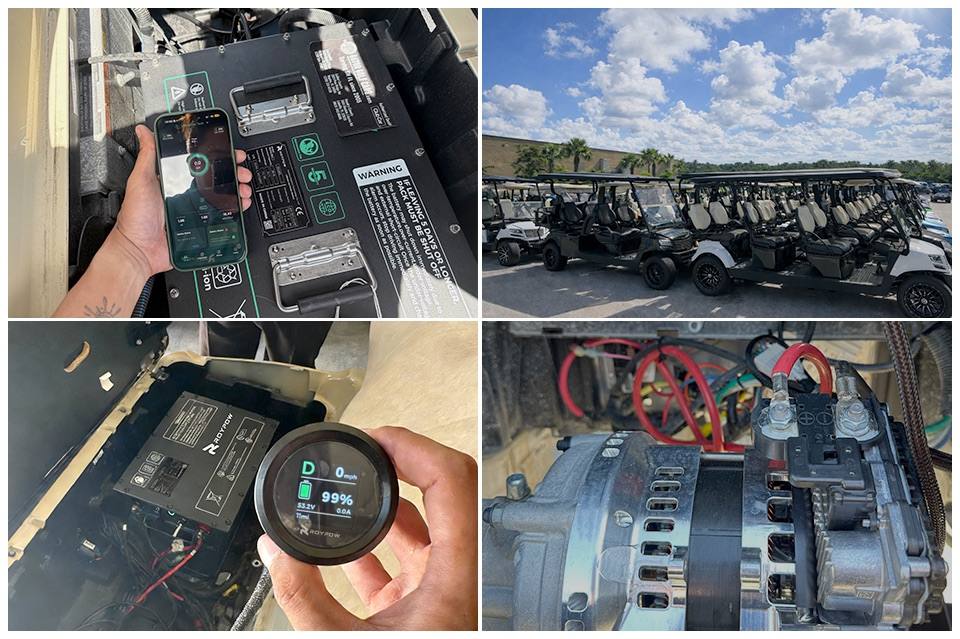
Step 8: Install the SOC meter or connect monitoring. Lithium voltage remains relatively flat across much of its discharge curve, so old lead-acid meters are often inaccurate. A cart can appear full for a long time and then drop quickly near the end if the meter is not designed for lithium. Use a shunt-based meter, BMS-connected display, Bluetooth app, or manufacturer-approved SOC indicator.
Mount the display where the driver can see it without distraction. For fleet carts, consider a location protected from vandalism, rain, and impact. Train users to respond to low SOC warnings and avoid deep discharge. In rental fleets, clear user instructions reduce stranded carts and service calls.
Step 9: Complete final connections and test. Before turning the cart on, review all connections: main positive, main negative, charger leads, SOC meter, DC-DC converter, accessory fuses, communication cables, and mounting hardware. Confirm no tools are left in the battery bay. Check pack voltage with a multimeter. Turn the cart on while wheels are clear of obstacles, then test forward and reverse at low speed.
Drive gently at first. Listen for unusual noises, check braking, verify acceleration, and confirm that accessories work. After a short test drive, stop and inspect cable temperature, terminal tightness, charger recognition, and SOC reading. Recheck torque after initial use if the manufacturer recommends it. Keep the installation manual and wiring photos with the cart records.
In hilly locations such as San Francisco, Cape Town, Wellington, Lisbon, or mountain resorts in Korea and Japan, perform a controlled hill test. Watch for BMS over-current protection, controller faults, or excessive cable heat. If the cart is used on public roads or low-speed vehicle routes, confirm lighting, mirrors, horn, reflectors, seat belts, and local compliance before returning it to service.
Problem Solving: Frequent Installation Issues and Fixes
Most lithium conversion problems come from a small group of causes: wrong voltage, incorrect charger, poor connections, undersized battery current rating, accessory wiring mistakes, old cart faults, or misunderstanding SOC behavior. A systematic approach prevents unnecessary part replacement.
| Symptom | Likely Cause | Practical Fix |
|---|---|---|
| Cart does not power on | Main disconnect off, incorrect polarity, loose cable, BMS asleep | Check switch positions, voltage, polarity, and wake-up procedure. |
| Charger will not start | Wrong charger, receptacle wiring issue, pack outside charge range | Use approved lithium charger and verify charger connections. |
| SOC meter reads incorrectly | Lead-acid meter still installed or meter not calibrated | Install lithium-compatible meter and follow calibration steps. |
| Cart cuts out on hills | Battery current rating too low, controller draw too high, weak cables | Check peak current demand, cable size, and BMS event data. |
| Accessories fail | No DC-DC converter, blown fuse, wrong accessory voltage | Install rated converter and fuse each accessory circuit. |
| Terminals become hot | Loose connection, corrosion, undersized cable, poor crimp | Stop use, inspect, replace damaged cables, torque correctly. |
| Range is lower than expected | Small capacity, tire drag, brake drag, hills, cold weather, heavy load | Audit load profile and mechanical condition; consider higher capacity. |
The troubleshooting table should be used from simple checks to advanced diagnosis. Do not repeatedly reset a fault without identifying why it occurred. BMS protection is a warning that the system has exceeded a limit or detected an abnormal condition.
If the cart feels slower after conversion, confirm that the battery is fully charged, the SOC meter is accurate, and the controller is not in a reduced mode. Also check tire pressure, brake drag, wheel bearings, and alignment. Lithium reduces battery weight, but mechanical resistance can still waste energy. Large tires and lift kits increase current demand and can reduce range.
If the charger becomes unusually hot, smells burnt, or shows inconsistent lights, disconnect it and inspect. Chargers should be matched not only by voltage, but also by charge current and profile. In fleet charging rooms, provide airflow and avoid coiling cables tightly while charging. Label outlets and chargers to reduce operator error.
If the BMS disconnects during regenerative braking, the system may be receiving current when the battery is full or outside acceptable limits. Some carts, especially those with aggressive regen behavior, require careful matching with lithium batteries designed for that platform. Consult the battery supplier or trained technician rather than disabling safety functions.
For service providers, diagnostic records are valuable. Note ambient temperature, SOC, cart load, slope, controller model, fault codes, charger model, and event timing. A dealer in Dallas, Birmingham, Munich, Osaka, São Paulo, Perth, or Johannesburg can solve problems faster when these details are available.
ROYPOW Capabilities and Global Support
ROYPOW TECHNOLOGY focuses on lithium battery systems and energy storage solutions, with more than two decades of experience in new energy applications. In the golf cart sector, the company develops LiFePO4 replacements for lead-acid batteries across common 36V, 48V, and 72V platforms. Its approach is built around motive power systems that help users reduce maintenance, improve runtime, and move toward cleaner electric operation.
Technological capabilities. ROYPOW maintains in-house research and development across battery management systems, battery pack design, system integration, industrial design, inverter technology, and software. For a golf cart lithium battery conversion, these capabilities matter because the battery is not just a box of cells. The BMS, thermal strategy, enclosure, communication, charger matching, and monitoring functions all influence safety and performance.
The company’s lithium focus means its engineering resources are directed toward LiFePO4 battery systems rather than lead-acid production. This specialization supports product lines for golf carts, forklifts, aerial work platforms, floor cleaning machines, scissor lifts, trolling motors, industrial vehicles, and energy storage. Lessons from demanding industrial applications help improve ruggedness and reliability in motive power products.
Manufacturing capabilities. ROYPOW operates manufacturing bases in China and Indonesia and has a large headquarters facility with automated production capabilities. The company uses advanced manufacturing execution systems and quality systems, with production supported by testing resources for cells, battery systems, BMS units, chargers, energy storage products, and hybrid inverter systems. For global customers, consistent manufacturing and testing are important because battery performance depends on repeatable assembly, quality control, and verification.
Battery systems used in golf carts must withstand vibration, repeated charging, varying climates, and daily cycling. Manufacturing discipline affects terminal integrity, enclosure sealing, BMS reliability, and charger compatibility. This is especially important for fleet buyers managing dozens or hundreds of carts across golf courses, resorts, universities, airports, warehouses, and industrial sites.
Service capabilities. ROYPOW serves customers through subsidiaries and regional teams in multiple markets, including North America, Europe, South America, Africa, the Middle East, Asia, and Australia. For global world buyers, local support is more than convenience. It helps with model selection, installation questions, warranty handling, dealer training, technical response, and after-sales service.
International standards and certifications also influence purchasing decisions. Buyers working with resorts, municipalities, logistics hubs, universities, or corporate campuses often need products that comply with recognized safety and quality expectations. ROYPOW products are designed with attention to international and North American standards, supporting customers who require documentation for procurement and compliance.
Beyond golf carts, ROYPOW’s broader product ecosystem includes battery chargers, DC-DC converters, 48V air conditioners, intelligent alternators, residential and commercial energy storage, marine systems, RV electrical systems, truck APU products, and electric retrofit solutions. This wider clean-energy portfolio reflects a long-term trend: more vehicles, machines, and facilities are shifting from fossil fuel or lead-acid systems toward smarter electrified platforms.
FAQ
1. Can any golf cart be converted to lithium?
Not every cart should be converted without inspection. Most healthy 36V, 48V, and 72V carts can be considered, but the controller, motor, wiring, tray condition, charger setup, and accessories must be compatible. Severely corroded, heavily modified, or electrically faulty carts should be repaired before conversion.
2. What is the best lithium chemistry for golf carts?
LiFePO4 is widely preferred for golf carts because it offers strong cycle life, stable performance, and good safety characteristics. It is well suited for motive power applications where daily charging, vibration, and high current demand are common.
3. Do I need to change my charger when converting?
In most cases, yes. A lithium-compatible charger with the correct voltage and charge profile is recommended. Some programmable chargers may be usable if approved and configured correctly, but many old lead-acid chargers are not suitable.
4. How much range will I get after conversion?
Range depends on battery capacity, cart weight, tire size, terrain, speed, passengers, cargo, weather, and driving style. Lithium often improves usable energy and voltage stability, but a small lithium pack may not outperform a large lead-acid bank in every situation. Match capacity to your real daily route.
5. Will lithium make my golf cart faster?
It may improve acceleration and maintain speed better under load because lithium voltage drops less than lead-acid voltage. However, top speed is mainly controlled by the motor, controller, gearing, tire size, and cart programming. Do not exceed safe or legal speed limits.
6. Are lithium golf cart batteries safe?
Quality LiFePO4 batteries with a properly designed BMS are considered safe when installed and used correctly. Safety depends on correct voltage, secure mounting, proper cables, approved charging, temperature protection, and avoiding unauthorized modifications.
7. Can I keep my 12V lights and accessories?
Yes, but they usually need a DC-DC converter when the main battery pack is 36V, 48V, or 72V. Accessories should be fused and wired correctly. Do not connect 12V devices directly across part of a lithium pack unless the manufacturer specifically permits it.
8. What should I do with my old lead-acid batteries?
Recycle them through an approved battery recycler, dealer, service shop, or local waste program. Lead-acid batteries contain recyclable materials and hazardous acid. Do not dump them, open them, or place them in household waste.
9. How should I store a lithium golf cart battery?
Store it in a dry, secure location within the temperature range recommended by the manufacturer. For long storage, leave it at the recommended state of charge and check it periodically. Avoid charging below the battery’s allowed temperature unless it has approved low-temperature charging protection.
10. What are the major 2026 trends in golf cart lithium conversion?
Key 2026 trends include smarter BMS monitoring, app-based diagnostics, better charger communication, improved fleet telematics, lighter high-capacity packs, stronger recycling programs, and stricter sustainability policies. Golf courses, resorts, ports, campuses, and municipalities are also placing more emphasis on low-maintenance electric fleets and responsible battery lifecycle management.