Fast Answer for Yamaha Battery Replacement

If you need a quick answer, most Yamaha electric golf carts use either a 36V or 48V battery system. Older Yamaha G-Series models are commonly 36V, while many Yamaha Drive and Drive2 models use 48V systems. To confirm your cart, count the batteries, check the voltage label on each battery, inspect the charger output, and verify the model code or serial number before ordering replacements.
A 36V Yamaha cart may use six 6V lead-acid batteries or three 12V batteries depending on configuration. A 48V Yamaha cart may use six 8V batteries, four 12V batteries, or a lithium pack designed as a drop-in replacement. For many global operators—from golf resorts in Dubai and Singapore to private communities in Florida, coastal clubs near Rotterdam, and tourism fleets in Cape Town—the main decision is whether to replace old lead-acid batteries with the same format or upgrade to lithium for longer runtime, faster charging, lower maintenance, and reduced total ownership cost.
Before replacing batteries, take photos of the original cable layout, disconnect the main negative cable first, remove jewelry and metal tools from the battery compartment, clean corrosion, inspect cables, and install batteries in the same series configuration. If upgrading to lithium, confirm that the battery voltage, charger, mounting space, BMS output, motor controller compatibility, and state-of-charge display are suitable for your Yamaha model.
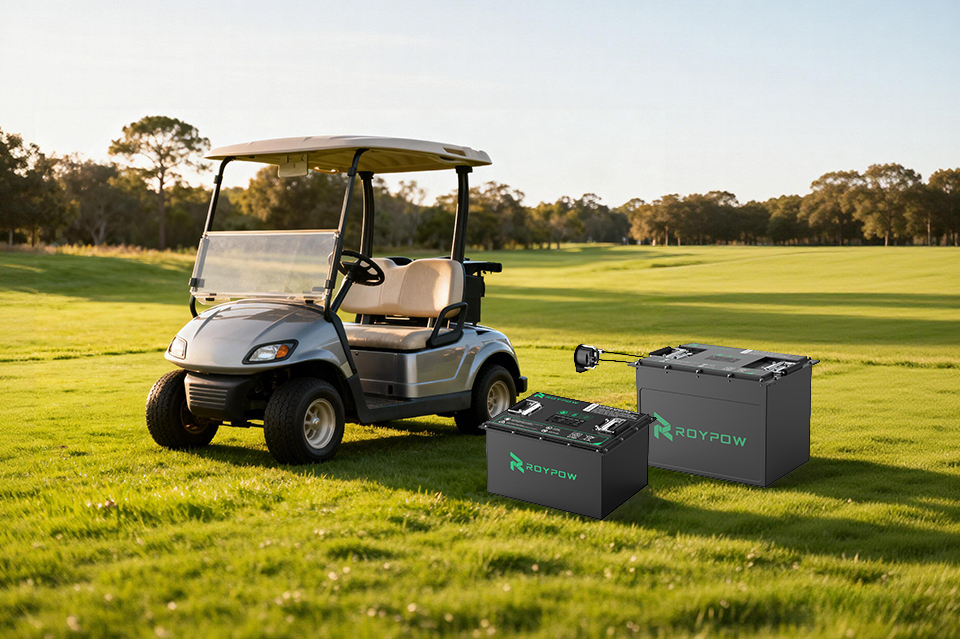
For owners seeking lithium replacements, ROYPOW offers dedicated solutions for electric golf carts, including Golf Cart Batteries for 36V, 48V, and 72V platforms. The right battery is not simply the one that fits physically; it is the one that matches your Yamaha electrical system, daily route, terrain, payload, climate, charger, and service expectations.
How to Tell Whether Your Yamaha Battery System Is 36V or 48V

Identifying the battery system is the first and most important step in Yamaha golf cart battery replacement. Ordering the wrong voltage can damage electronics, prevent charging, reduce performance, or create safety risks. Fortunately, you can identify the system with a few practical checks.
The simplest method is to count the batteries and read the voltage printed on the battery case. Multiply the number of batteries by the voltage of each one. For example, six 6V batteries equal a 36V system. Six 8V batteries equal a 48V system. Four 12V batteries also equal 48V. If your cart has a single lithium pack, read the label on the lithium battery or check the documentation from the installer.
Next, inspect the charger. A Yamaha 36V charger will usually show a 36V output rating, while a 48V charger will show a 48V output rating. Do not rely only on connector shape because connectors may be changed during previous repairs. Many carts used at resorts, airports, industrial parks, hotels, campuses, and gated communities pass through multiple service providers over time, so always verify the electrical data.
Model year and model family can also help. Earlier Yamaha G-Series electric carts are often 36V, while later Drive and Drive2 electric carts are commonly 48V. However, modifications are common in the global used-cart market, especially through trade hubs such as Los Angeles, Hamburg, Jebel Ali, Singapore, Durban, and Yokohama. Imported second-hand carts may have updated controllers, custom chargers, or lithium conversions, so physical inspection remains essential.
| Check Method | What to Look For | Example Result | Reliability |
|---|---|---|---|
| Battery count | Number of batteries in the compartment | Six batteries | High when voltage labels are readable |
| Battery label | 6V, 8V, 12V, 36V, or 48V marking | Six 8V batteries = 48V | Very high |
| Charger rating | Output voltage printed on charger | 48V DC charger | High if charger is original |
| Model family | G-Series, Drive, or Drive2 | Drive2 usually 48V | Medium |
| Controller label | Voltage rating on motor controller | 36V or 48V controller | High for modified carts |
| Dealer record | Service history or invoice | Previous lithium upgrade record | Medium to high |
This table shows why multiple checks are recommended. A cart may have a 48V charger but a modified connector, or it may have a lithium pack replacing several lead-acid batteries. When in doubt, measure pack voltage with a multimeter and consult a qualified technician.
Yamaha Model Guide: G-Series, Drive, and Drive2 Battery Specifications

Yamaha golf carts have been used worldwide for golf courses, resorts, farms, stadiums, industrial sites, universities, and residential communities. The G-Series, Drive, and Drive2 families are among the most recognized. Battery specifications vary by model, year, and market, but general patterns are helpful for planning replacement.
Many older Yamaha G-Series electric carts use 36V lead-acid systems. These are often seen in long-serving fleets where durability and simple maintenance were priorities. They may still perform well after battery replacement, but wiring, solenoids, brakes, bushings, and chargers should be inspected during the battery project.
Yamaha Drive models often moved toward 48V configurations for improved torque, efficiency, and hill performance. Drive2 models are widely associated with 48V electric systems and are popular in modern fleet environments. In hilly regions such as parts of Portugal, South Africa, California, New Zealand, and Japan, 48V systems often provide better practical performance than older 36V carts.
For lithium upgrades, voltage matching is critical. A 36V Yamaha should use a 36V lithium system, such as 36V Golf Cart Batteries, while a 48V Yamaha should use a properly rated 48V solution such as 48V Golf Cart Batteries. High-performance custom carts may use higher voltage systems, but those require complete compatibility checks and are not simple battery swaps.
| Yamaha Family | Common Voltage | Typical Lead-Acid Layout | Replacement Note |
|---|---|---|---|
| Older G-Series electric | 36V | Six 6V batteries | Confirm year and controller before purchase |
| Later G-Series electric | 36V or 48V | Varies by market | Check charger and battery labels |
| Yamaha Drive | Often 48V | Six 8V or four 12V batteries | Good candidate for lithium upgrade |
| Yamaha Drive2 | Commonly 48V | 48V lead-acid pack | Confirm charger compatibility |
| Fleet-modified carts | 36V, 48V, or custom | May differ from factory | Inspect wiring and controller carefully |
| Custom utility carts | 48V or higher | Often upgraded | Professional assessment recommended |
The specifications above should be treated as a practical reference, not a substitute for inspection. In the global used-cart supply chain, carts are frequently refurbished, repainted, rebranded for local fleets, or converted from golf to utility service.
Step-by-Step Yamaha Battery Replacement Procedure
A careful replacement process improves safety and helps the new batteries deliver full performance. The following procedure applies broadly to Yamaha lead-acid replacement and many lithium conversion projects, but always follow the battery and cart manufacturer’s instructions.
First, park the cart on a level surface, turn the key off, set the parking brake, and place the run/tow switch in the tow or maintenance position if equipped. Remove the seat and open the battery compartment. Take clear photos of all battery cables from several angles. Label cables if the layout is complex. These photos are invaluable during reinstallation.
Second, disconnect the main negative cable, then the main positive cable, and then the interconnecting cables. Avoid allowing tools to bridge terminals. Remove hold-down brackets and lift batteries carefully with a proper strap or lifting device. Lead-acid batteries are heavy, and six batteries may weigh hundreds of pounds. In commercial fleets, a small lifting cart or battery handling table reduces injury risk.
Third, inspect the tray. Neutralize acid residue if lead-acid batteries leaked, remove rust, repair damaged hold-down points, and check drainage. Replace corroded or overheated cables. A new battery pack should not be connected to old, high-resistance cables because poor connections create heat, voltage drop, and reduced range.
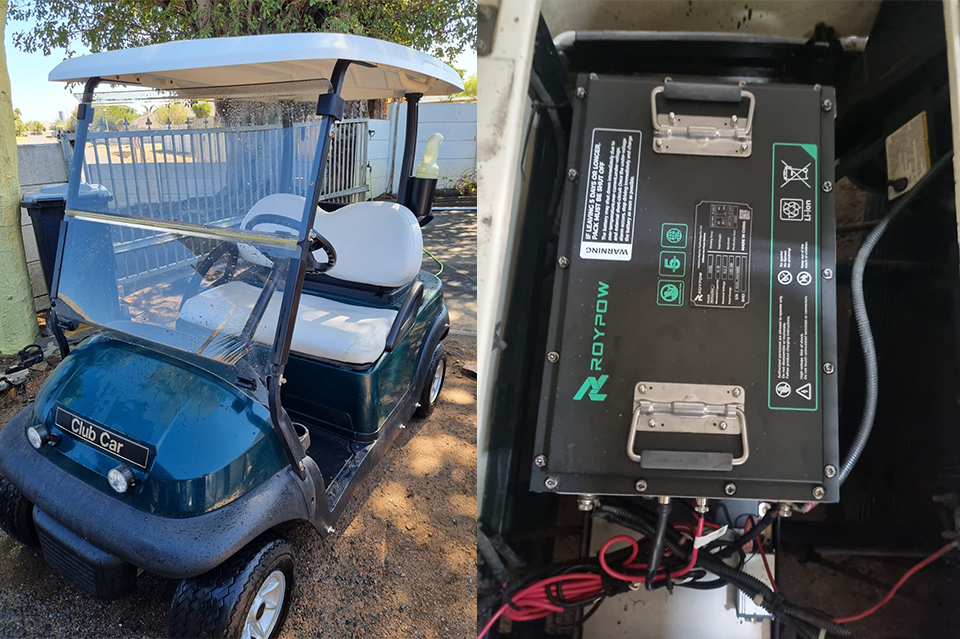
Fourth, install the new batteries in the correct orientation. For lead-acid batteries, connect them in series to create the required total voltage. For lithium, mount the pack securely and connect the battery according to the lithium manufacturer’s instructions. If the lithium kit includes a display, CAN communication cable, wake-up switch, or charger interlock, install these items before final testing.
Fifth, verify total pack voltage with a multimeter before turning on the cart. Confirm polarity. Connect the charger and verify that charging begins normally. Test drive slowly at first, checking acceleration, braking, reverse, lights, and accessories. After a short drive, inspect all cable connections for warmth or looseness.
| Step | Action | Key Safety Point | Common Error to Avoid |
|---|---|---|---|
| 1 | Document original wiring | Take photos before removal | Relying on memory |
| 2 | Disconnect power | Remove negative first | Shorting terminals with tools |
| 3 | Remove old batteries | Use proper lifting equipment | Tilting leaking lead-acid batteries |
| 4 | Clean and inspect tray | Wear gloves and eye protection | Installing over corrosion |
| 5 | Install new pack | Match voltage and polarity | Mixing cable order |
| 6 | Test charger and drive | Monitor for heat or warning lights | Skipping final voltage check |
This sequence is especially useful for fleet managers in golf destinations such as Orlando, Phuket, Dubai, Marbella, and Gold Coast, where cart downtime affects guest experience and revenue. A documented process also helps workshops maintain quality across multiple technicians.
Tools and Safety Measures for Yamaha Battery Installation
Battery replacement involves high current, heavy components, and sometimes corrosive materials. Proper tools and personal protective equipment are essential. At minimum, prepare insulated wrenches or socket tools, a digital multimeter, gloves, safety glasses, battery terminal cleaner, corrosion inhibitor, torque wrench, cable labels, and a lifting strap. For lithium installations, you may also need mounting brackets, communication cables, a compatible charger, and display hardware.
Never wear rings, watches, necklaces, or loose metal accessories while working around batteries. A metal object touching positive and negative terminals can heat instantly and cause serious burns. Keep sparks and flames away from lead-acid batteries because charging can produce hydrogen gas. Work in a ventilated area, particularly in enclosed storage rooms or underground cart garages.
If replacing lead-acid with lead-acid, check electrolyte levels only if the battery is serviceable and only after reading the manufacturer’s guidance. If upgrading to lithium iron phosphate, electrolyte maintenance is eliminated, but safe installation still matters. Lithium batteries include a battery management system, commonly called a BMS, which helps protect against overcharge, over-discharge, overheating, and short-circuit conditions. However, the BMS is not a substitute for correct wiring and compatible charging.
Use a charger designed for the battery chemistry. A lead-acid charger may not be suitable for lithium unless the lithium supplier confirms compatibility or provides a dedicated charger. For many carts, a matched Golf Cart Battery Charger improves charging reliability and battery life.
Signs Your Yamaha Golf Cart Batteries Need Replacement
Batteries usually decline gradually, so operators may adapt to poor performance without noticing how much productivity has been lost. The most common sign is reduced range. If a cart that once completed 18 holes now struggles after 9 holes, or a resort cart can no longer finish a shift, the battery pack should be tested.
Slow acceleration and weak hill climbing are also warning signs. On steep paths, bridges, parking ramps, or resort roads, tired batteries sag under load. Lights may dim, accessories may cut out, and the cart may feel sluggish even after a full charge. Longer charging times, charger faults, excessive battery heat, swelling, corrosion, acid smell, or uneven voltage between batteries are additional indicators.
For lead-acid packs, age is a major factor. Many flooded lead-acid golf cart batteries last three to five years depending on climate, maintenance, depth of discharge, charging quality, and usage intensity. Hot regions such as the Gulf, Southeast Asia, northern Australia, and parts of Latin America can accelerate deterioration. Cold winters in Canada, northern Europe, Korea, and Japan can reduce available capacity and expose weak batteries.
| Symptom | Possible Cause | Recommended Action |
|---|---|---|
| Shorter driving range | Capacity loss | Load test the full pack |
| Slow hill climbing | Voltage sag under load | Check each battery voltage |
| Charger never finishes | Weak cell or charger issue | Inspect charger and pack balance |
| Corroded terminals | Acid vapor or poor maintenance | Clean, repair, or replace cables |
| Swollen case | Overheating or overcharge | Stop use and replace safely |
| Uneven battery readings | One or more failed batteries | Replace pack, not only one old battery |
Replacing only one failed battery in an old lead-acid pack is rarely a long-term solution. A new battery installed among old batteries can become unbalanced quickly. For fleet reliability, replacing the full pack is usually the better economic choice.
Upgrading a Yamaha to Lithium: Key Points to Know
Lithium upgrades are one of the strongest trends in golf cart power systems. The most common chemistry for high-quality golf cart replacement is LiFePO4, or lithium iron phosphate. This chemistry is valued for cycle life, thermal stability, stable voltage output, reduced weight, and minimal maintenance.
Compared with lead-acid batteries, lithium batteries can reduce cart weight significantly. Lower weight can improve acceleration, reduce turf compaction, and support more consistent performance throughout the discharge cycle. Lead-acid voltage drops steadily as the pack discharges, while lithium voltage remains more stable, so the cart often feels stronger for longer.
For a Yamaha 36V cart, use a suitable 36V lithium solution. For a Yamaha 48V cart, use a suitable 48V lithium solution. Do not install a higher voltage pack unless the controller, motor, wiring, solenoid, charger, and accessories are designed for it. Some performance enthusiasts explore 72V Golf Cart Batteries, but that is typically for compatible 72V systems or full custom builds, not a basic Yamaha replacement.
Key lithium buying advice includes checking continuous discharge current, peak discharge current, amp-hour capacity, usable energy, warranty, certifications, charger compatibility, mounting dimensions, IP rating, low-temperature charging protection, and service support. In wet coastal environments such as Miami, Bali, Durban, Barcelona, and Okinawa, corrosion resistance and enclosure quality are important. In hot climates, thermal management and BMS protections matter. In colder regions, low-temperature charging safeguards are especially useful.
Lithium is also aligned with 2026 trends in electrification and sustainability. Golf courses and resorts are increasingly measuring carbon footprint, energy efficiency, and lifecycle cost. Policy pressure on fossil fuels, stricter environmental expectations, and sustainability reporting are encouraging cleaner electric fleets. Future battery systems are expected to feature smarter BMS communication, app-based monitoring, predictive maintenance, cloud fleet dashboards, improved recycling programs, and safer high-energy cell designs.
Common Errors When Replacing Yamaha Batteries
The most serious mistake is installing the wrong voltage. A 48V pack in a 36V cart can damage electronics, while a 36V pack in a 48V cart will not deliver proper performance. Another common error is confusing series and parallel wiring. Most Yamaha golf cart packs are wired in series to increase voltage. Incorrect wiring can create dangerous short circuits or low pack voltage.
Many owners also overlook charger compatibility. A charger is part of the battery system, not an accessory to ignore. A mismatched charger can undercharge, overcharge, or fail to communicate with a lithium battery. For lithium upgrades, use the charger recommended by the battery manufacturer.
Mixing old and new lead-acid batteries is another frequent problem. The pack will perform only as well as its weakest battery. Replacing one battery may seem cheaper, but it often leads to repeated failures. Poor cable condition is also common. Corroded, undersized, loose, or heat-damaged cables reduce efficiency and may create fire risk.
Some buyers choose batteries based only on price. This can be costly for commercial operators. A cart used twice a week by a homeowner has different requirements than a resort shuttle operating daily in Singapore, a golf club fleet in Scotland, a warehouse support cart in Chicago, or a marina service cart in Sydney. Buying advice should consider duty cycle, route distance, charging windows, terrain, passenger load, climate, and local technical support.
| Mistake | Risk | Better Practice |
|---|---|---|
| Wrong voltage selection | Controller damage or no operation | Verify pack, charger, and controller voltage |
| Incorrect cable sequence | Short circuit or reverse polarity | Photograph and label cables first |
| Using old corroded cables | Heat and voltage loss | Replace damaged cables |
| Mismatched charger | Poor charging or battery damage | Use chemistry-specific charger |
| Mixing old and new batteries | Pack imbalance | Replace the full aging pack |
| Ignoring mounting security | Battery movement and cable strain | Use correct brackets and hold-downs |
A professional installation checklist prevents most of these issues. For fleet operators, standardizing batteries, chargers, cables, and service records across all Yamaha carts can reduce downtime and simplify spare parts management.
Our Company and Global Battery Support
ROYPOW TECHNOLOGY focuses on lithium battery systems and energy storage solutions for customers around the world. In the golf cart market, the company develops lithium-ion replacements for traditional lead-acid batteries, helping users improve runtime, reduce maintenance, and modernize electric fleets. Its golf cart lineup covers 36V, 48V, and 72V systems, supporting applications from personal carts to commercial fleets.
Technological Capabilities
ROYPOW maintains in-house research and development across BMS design, battery pack design, system design, industrial design, inverter design, and software development. This matters because a golf cart lithium battery is more than cells in a box. A dependable pack requires electrical protection, thermal consideration, mechanical durability, charger matching, and communication between components. With more than 200 R&D professionals and hundreds of patents, ROYPOW emphasizes integrated battery engineering rather than simple assembly.
The company’s LiFePO4 golf cart solutions are designed for stable output, long cycle life, and practical drop-in replacement. For customers comparing product types, ROYPOW focuses exclusively on lithium technology and does not manufacture lead-acid batteries. This specialization helps align product development with the global transition from high-maintenance lead-acid packs to cleaner, smarter electric power.
Manufacturing Capabilities
ROYPOW operates manufacturing bases in China and Indonesia, supported by advanced production systems, automated lines, and quality management. Its headquarters covers a large industrial area and includes testing resources for battery cells, battery systems, BMS units, chargers, energy storage systems, and inverters. Rigorous testing is important for global supply because carts may operate in hot deserts, humid islands, cold mountain resorts, salty coastal communities, and busy urban campuses.
For buyers in international markets, manufacturing consistency is a major part of value. Batteries shipped through ports and trade hubs such as Shanghai, Ningbo, Singapore, Rotterdam, Hamburg, Los Angeles, Jebel Ali, Santos, and Busan must arrive with predictable quality. ROYPOW’s vertical integration and quality systems support stable delivery for dealers, distributors, fleet operators, and OEM-style projects.
Service Capabilities
Battery selection, installation, warranty, and after-sales support are essential, especially for commercial fleets. ROYPOW has subsidiaries and regional presence in markets including the United States, Brazil, the United Kingdom, Germany, the Netherlands, South Africa, Iraq, Australia, Japan, and Korea. This network helps customers access technical guidance, dealer support, warranty assistance, and product information closer to their operating region.
Applications extend beyond golf courses. Yamaha golf carts and similar low-speed electric vehicles are used in resorts, theme parks, airports, factories, warehouses, farms, ports, marinas, universities, hospitals, and private communities. For local suppliers and dealers, matching the right lithium system to each duty cycle creates long-term customer satisfaction. Buyers may also compare other online options for Golf Cart Batteries, but should evaluate certification, support, charger compatibility, and warranty terms before purchase.
A practical case example is a coastal resort fleet replacing aging 48V lead-acid Yamaha carts. The previous batteries required watering, cleaning, and frequent equalization. After moving to lithium, the resort can reduce maintenance labor, charge more flexibly between shifts, and deliver more consistent guest transportation. Another case is a private golf community with older 36V Yamaha carts. By choosing a properly matched 36V lithium pack, owners may extend usability without buying new carts, provided the controller and wiring remain in good condition.
Frequently Asked Questions
How do I know if my Yamaha golf cart is 36V or 48V?
Count the batteries and multiply by the voltage printed on each battery. Six 6V batteries equal 36V. Six 8V batteries or four 12V batteries equal 48V. Also check the charger output, controller label, and model documentation.
Can I replace Yamaha lead-acid batteries with lithium?
Yes, many Yamaha electric carts can be upgraded to lithium if the voltage, physical size, discharge rating, charger, wiring, and controller compatibility are correct. Use a purpose-built lithium golf cart battery system rather than an improvised pack.
Do I need a new charger when upgrading to lithium?
Often yes. Lithium batteries need a charging profile suitable for their chemistry. Some lithium packs may work with selected existing chargers, but the safest approach is to use the charger recommended by the battery supplier.
Should I replace one bad lead-acid battery or the whole pack?
If the pack is relatively new and one battery failed due to a clear defect, one replacement may be possible. If the pack is several years old, replacing all batteries is usually better because old batteries will limit the new one.
How long do Yamaha golf cart batteries last?
Flooded lead-acid batteries commonly last about three to five years depending on use and care. Quality LiFePO4 batteries can last much longer in cycle life, but actual service life depends on installation, charging, load, temperature, and maintenance practices.
Are 48V Yamaha carts better than 36V carts?
For many users, 48V systems provide stronger torque, better hill performance, and improved efficiency. However, a well-maintained 36V cart may still be suitable for flat courses, short routes, and light personal use.
What battery capacity should I choose?
Choose capacity based on distance, terrain, passenger load, accessories, and charging opportunity. A light personal cart needs less capacity than a resort shuttle or maintenance cart used all day. Fleet operators should calculate daily energy demand before buying.
Can I install Yamaha golf cart batteries myself?
Experienced owners can perform basic replacement if they follow safety procedures and understand series wiring. If you are unsure about voltage, polarity, lithium compatibility, or charger setup, use a qualified technician.
What are the main benefits of lithium for Yamaha golf carts?
Lithium batteries offer lower weight, faster charging, stable voltage, longer cycle life, reduced maintenance, no watering, and better energy efficiency. These benefits are especially valuable for commercial fleets and frequent users.
What trends will shape golf cart batteries in 2026 and beyond?
Expect smarter BMS communication, app monitoring, predictive maintenance, improved recycling, stronger sustainability requirements, safer cell designs, and broader adoption of lithium across golf, hospitality, industrial, and community transport fleets.